What American football odds really cost the punter in 2026
 Available in US
Current as of October 30, 2026. Operator details and licence numbers checked against the Gambling Commission’s public register.

American football sits in an odd corner of the British betting market. The Super Bowl draws more single-event interest than almost anything outside the Premier League, the regular season runs through autumn and winter, and a small hardcore of bettors follows the NFL, the CFL and the college game week by week. Yet the sport is also the one where the marketing language most aggressively oversells what the price actually delivers, where a “boost” rarely beats the margin, and where a 50% bonus looks generous until the turnover requirement is read.
This page goes through that gap. The fixtures and tournaments that take a bet, the markets British bookmakers actually offer, how the odds are built, and what ten GB-licensed operators charge for the same fixture. The lens is cost: what a price, a bonus or a market takes out of the stake before the bet is even placed.
Fixtures, season structure and what takes a bet
American football is a four-quarter, 60-minute contest between two sides of eleven players on each side of the ball. Games do not usually finish in a draw, and that matters for the betting menu: the two-way market is the spine of every bookmaker’s NFL offering, and where a third outcome exists, it sits as a much longer price.
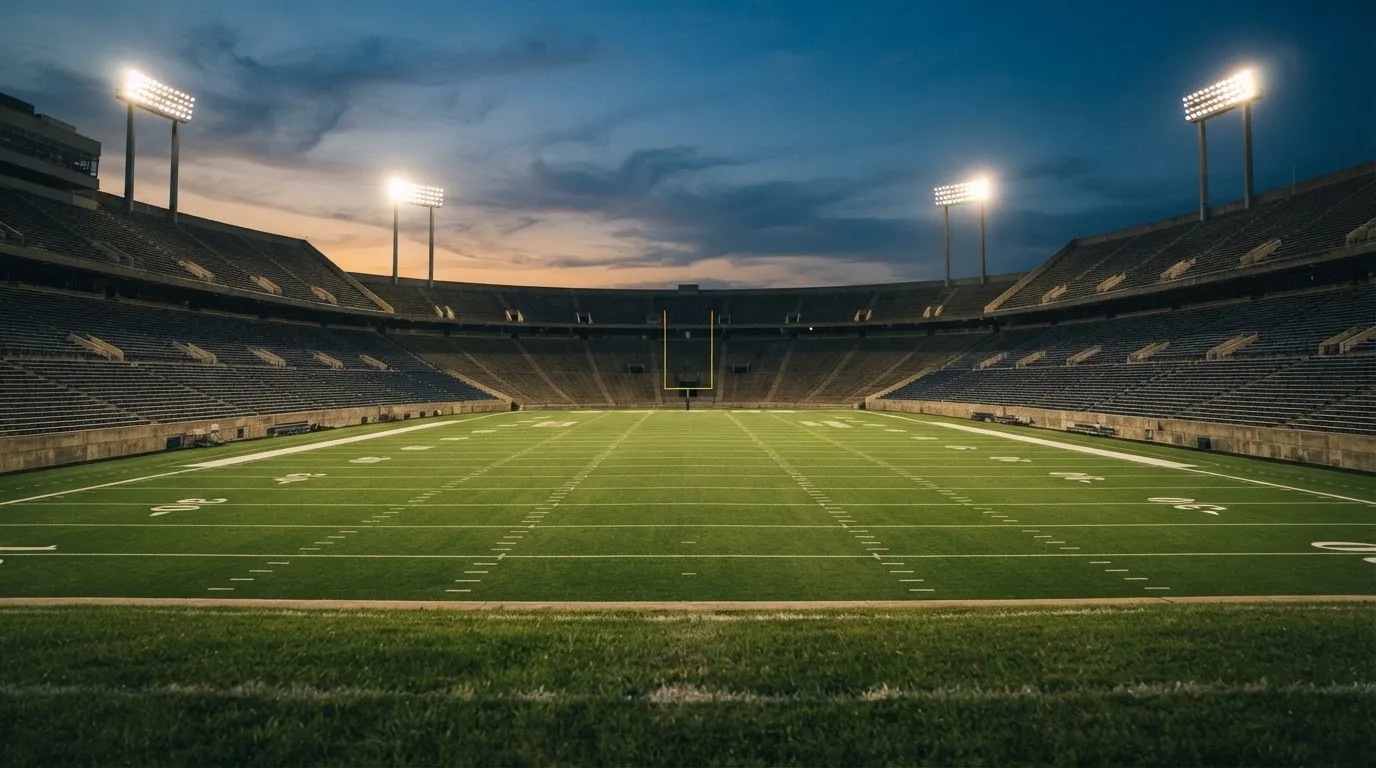
The professional game is the NFL — 32 teams split between the AFC and the NFC, 17 games across an 18-week regular season, then 14 teams in a single-elimination post-season. The last Super Bowl played was Super Bowl LX, on 8 February 2026 at Levi’s Stadium in Santa Clara, with the Seattle Seahawks beating the New England Patriots 29-13 and Kenneth Walker III taking the MVP award. The next one is what the season ahead builds towards, and the regular-season schedule for the new campaign is the period punters actually live in week to week.
Alongside the NFL, three other competitions shape the year. The CFL runs through the British summer, when the NFL is in pre-season; the NCAA college game, principally Division I FBS, runs in parallel with the NFL and offers a long menu of spreads and totals on games that move quickly with breaking news; and the UFL, the spring league that absorbed the XFL, gives an off-season product. Most GB-licensed bookmakers cover the NFL and the college game in depth, lighter coverage of the CFL, and a thin offering on the UFL.
The off-season does not stop the betting — it merely changes the menu. From February to August the bookmakers carry NFL futures: division winners, conference champions, Super Bowl outright, season win totals, the first overall pick in the Draft, and a growing market on player awards. Once pre-season kicks off, the menu shifts to game lines and team props, then to full game-by-game coverage from Week 1 in September.
Scoring, settlement and what a “push” actually means
A punter who has spent the last few years on football or horse racing walks into NFL betting carrying assumptions that bite them. The scoring is unlike anything else on the British sportsbook. A touchdown is six points; the extra-point kick that follows is one; a two-point conversion, run or passed, is two; a field goal is three; a safety, awarded to the defence for tackling an opponent in its own end zone, is two. A game that ends 24-17 has had four touchdowns, three extra points, a two-point conversion and a field goal — the kind of mix that makes player-prop markets (anytime touchdown scorer, passing yards, rushing yards) a richer hunting ground than the headline spread.

Three settlement rules trip up newcomers. First, overtime: unless the bookmaker’s market specifically excludes it, the result includes the extra period. A spread bet on a side that loses in overtime is still a loss, even when the regulation result was a winner. Second, the push: when the handicap or the total lands exactly on the quoted line, the bet is made void and the stake returned. A 3.5-point spread never pushes because half-points cannot be tied; a 3-point spread can. The same rule applies to totals — Over 44.5 is binary, Over 44.0 can push. Third, listed pitchers and the no-pitcher equivalent in football: the standard rule is that all bets stand once the game kicks off, but a postponed or abandoned event is usually made void under the operator’s own rules.
The two-way market sits at the heart of the price. There is no draw in the NFL — a regular-season game cannot end level, and the post-season runs overtime until a winner is found. A bookmaker therefore prices each side against the other, and the margin the operator keeps is built into both sides of the same event. That is the difference between betting on football and betting on, say, League Cup football, where the draw sits as a third outcome priced at longer odds.
The bet types a GB bookmaker actually prices
A spread, a total and a moneyline are the three markets that anchor every fixture card. Everything else — player props, team props, same-game accumulators, derivatives — is built on top of them.
The spread is a handicap. The favourite is given a negative number of points; the underdog a positive one. A bet on the favourite at -3.5 wins if the side wins by four or more; a bet on the underdog at +3.5 wins if the side either wins outright or loses by three or fewer. Half-point spreads eliminate the push; whole-number spreads reintroduce it. A bookmaker’s spread is rarely more than a point or two off the market consensus for a high-profile game, because a line that drifts invites arbitrage.
The total is a single number set for the combined points scored by both teams, with the punter backing Over or Under. Lines for a primetime NFL game typically sit between 41.5 and 51.5 points. Movement in the total is the cleanest read on the market’s expectation of pace and offensive production.
The moneyline is the straight winner. The favourite pays a price shorter than evens, often 1.40 to 1.70 (2/5 to 7/10) in decimal; the underdog pays 2.20 to 3.50 (6/5 to 5/2) or longer. For many casual punters, the moneyline is where the marketing message and the actual value most violently disagree, because the price on the favourite is so short that a winning bet barely beats the stake.
Player props are the fastest-growing segment. Anytime touchdown scorer, first touchdown scorer, over/under on a quarterback’s passing yards, a receiver’s receptions, a running back’s rushing yards. Most props are priced with their own margin, often a wider one than the headline market. The bookmaker’s edge is in markets the punter is less equipped to price themselves.
Same-game accumulators — the British term is “Bet Builder” — combine several selections from a single fixture into one price. The legs multiply; the margin is harder to see because the per-leg margin is no longer listed separately. A Bet Builder is a fine way to make a game interesting for a small stake, and a poor way to find value: the price the punter sees is the price the bookmaker has set, and the bookmaker sets prices to keep a margin, not to pass it on.
Futures are season-long outrights. Division winner, conference champion, Super Bowl winner, season win totals, MVP, Offensive and Defensive Rookie of the Year, Coach of the Year. The market runs for months, the line moves on every result, and a long-priced bet at 100/1 carries the bookmaker’s full margin baked in, with no way for the punter to know what that margin is.
Live betting sits on top of all of this once the game kicks off. The pace of the NFL — discrete plays separated by clear stoppages — is friendlier to in-play pricing than football or tennis. Spreads, totals, moneyline, next-play markets, drive markets, the next team to score: the menu is wide. The trap is that the in-play price also carries the bookmaker’s margin, often a wider one than the pre-match equivalent, because the operator is pricing into uncertainty.
How the odds are built and where the margin hides
A bookmaker’s margin is the cut it keeps on every market. It is not a fee charged separately; it is baked into the prices on both sides of every event. The way to see it is to convert each price to its implied probability and add the probabilities together. If the sum is greater than 100%, the difference is the margin.
A worked example. Take a two-way market priced at 1.90 and 1.90 — fractional 9/10 on each side. The implied probability of each is 1 ÷ 1.90, which is 52.63%. Add the two: 105.26%. The bookmaker’s margin is the excess over 100%, so 5.26% on this market. That is the cut the operator keeps on every pound staked, before the result is even known.
The same arithmetic on a market priced at 1.83 and 2.00 (roughly 10/11 and evens) gives 1 ÷ 1.83 = 54.64% and 1 ÷ 2.00 = 50.00%, summing to 104.64% — a margin of 4.4%, slightly better for the punter. On a market priced at 1.70 and 2.20 (roughly 7/10 and 6/5), the implied probabilities are 58.82% and 45.45%, summing to 104.27% — a margin of 4.1%. The tighter the line and the closer the prices, the lower the margin, because the bookmaker has a balanced book to manage and is competing hard for the action.
A margin of 5% on a two-way NFL spread is in the typical band. A margin of 7% or higher is wide, and it appears on player props, on small-market games, and on season-long futures where the operator has less competitive pressure. A margin below 4% usually means the bookmaker is sharpening the line for a primetime fixture and expecting to balance the book; the punter faces a tighter line but a more honest price.
The implication is uncomfortable for the marketing message. A “best odds” or “boosted price” headline that quotes a single price tells the punter nothing about the margin on the other side of the market, and the boost is often funded by widening the other selection rather than narrowing the operator’s cut. The honest comparison is between the margins, not between the prices.
Tips, predictions and what a “tipster” actually sells
A search for American football tips returns a tidal wave of content: tipsters on social media, paid tipster services, and AI-driven prediction platforms. The honest framing is that no one knows the outcome of a future game. A tipster is selling a process, not a result, and the process is worth what it is worth regardless of the headline strike rate.
Three things separate a process worth paying attention to from a process that is not. First, a verifiable record. A tipster who publishes picks but does not publish the closing line, the bookmaker used and a settled profit-and-loss statement over hundreds of bets is selling marketing, not analysis. Closing line value — how often a tipster’s pick beats the price at kick-off — is the single best measure of edge, because the closing line is where the sharp money lands. Second, sample size. A 10-bet sample at 70% strike rate is, statistically, indistinguishable from a 50% tipster who got lucky. Anything below 500 bets is a thin signal. Third, the staking plan. A flat one-unit stake across every pick is the only way to read a record honestly; a tipster who increases the stake on losers and decreases it on winners is smoothing the curve, not improving the edge.
The national-team and league equivalent in football is the way most sharp money expresses itself in NFL markets: line-shopping across several bookmakers for the best price on the same fixture, then staking a fixed unit. That is not a tip. It is a discipline, and it is what the marketing language of “best odds” actually points at, if the marketing language is honest.
Where the bonus really lives, and what it costs
The welcome bonus is the most heavily advertised feature of every GB-licensed sportsbook, and the least well understood. A “50% back as a free bet of up to £50” sounds like a free £50; what it actually is, in the operator’s own terms, is a credit that pays the winnings but does not pay the stake back, with whatever expiry and minimum-price rules the operator’s terms add.
A worked example on the simplest kind of welcome. The operator gives £40 in free bets when the new customer stakes £20 at minimum odds of 2.0 (1/1). The £20 is a real cash bet; the £40 in free bets is a credit. A free bet at 2.0 that wins pays out 2.0 × £40 = £80, of which the stake is not returned — the punter keeps £40 profit. A free bet at 1.50 that wins pays 1.5 × £40 = £60, profit £20. A free bet that loses pays nothing. The average value of a free bet, across many uses at the market’s typical margin, sits well below its face value.
The British regulator has tightened the rules. Since 19 January 2026, wagering requirements on bonuses are capped at 10x — a £10 bonus at 50x required £500 of bets; under the cap no more than £100 of turnover is required for that £10 of bonus. Mixed-product promotions, such as a sports bet to unlock free casino spins, are banned. The cap does not, however, change the basic arithmetic: a bonus is a marketing cost the operator prices into its margin, and the punter pays for it through less competitive odds on the rest of the menu.
A price boost is a different mechanism. The operator raises the price on a specific market for a limited window, usually to a headline number. The punter reads the headline, stakes the maximum allowed, and the bet settles. The honest framing is that a price boost is a small, time-limited discount on an otherwise standard margin — useful for the punter who was going to bet the market anyway, irrelevant to the punter who was not.
Best Odds Guaranteed is a third mechanism, and the one with the cleanest value. On UK and Irish horse racing, several bookmakers guarantee to pay the bigger of the price taken and the starting price from a stated time on race day — at Fafabet from 9am, at William Hill from 8am. The mechanism does not apply to American football, where there is no SP, but the structure is what the market refers to when it says a price is “boosted” or “best”.
Accumulator insurance is a fourth. A bookmaker refunds a losing accumulator as a free bet if exactly one leg lets the punter down. The refund is a free bet, not cash, and the terms usually cap the refund, the number of legs, and the minimum price per leg. The arithmetic on a 5-fold with one losing leg is that the punter keeps the stake and gets a free bet of the stake back; the free bet’s value, used once, sits well below its face value. The punter who reads “acca insurance” as “free bet if I lose” has read the headline and missed the line.
Cash out, live betting and the in-play menu
Live betting on American football is the one area where the GB market genuinely leads. The pace of the NFL — discrete plays, timeouts between drives, the two-minute warning, the natural break after a score — is a near-perfect structure for in-play markets. Spreads move on every score, totals move on every drive, next-play markets price the immediate action, and the menu is wider than for almost any other sport.
Cash out sits on top. A bookmaker offers a price on an open bet, the punter takes it, the bet is settled at that price. A punter who backed a side at -3.5 and the side leads by seven at half-time can cash out at a price reflecting the new state of the game, locking in profit before the second half. The catch is that the cash-out price carries its own margin, separate from the margin on the original market, and that margin is wider than the punter expects. A bookmaker does not lay off every cash-out at a fair price; it prices the cash-out to keep a slice on the action whichever way the bet goes.
In-play markets that are useful to the punter:
- The next score (touchdown, field goal, safety), with the price updating as the drive develops.
- The result of the current drive (touchdown, field goal, no score, turnover).
- The spread and total, which move with every score.
- Team-specific markets for the rest of the game (next team to 10 points, next team to 20).
In-play markets that are mostly marketing:
- A continuous stream of micro-markets priced on a small section of the field, with a margin so wide that the punter cannot tell from the headline whether the price is fair.
- Player props on the next play (next pass, next run, next score by player X), with a margin that grows with the uncertainty.
The discipline is the same as on the pre-match menu: compare the implied probability to an honest assessment, and walk away when the margin is wider than the edge.
Crypto, anonymous play and the GB-licensed reality
The marketing pages for “crypto American football betting” make a different pitch: no verification, no identity check, deposits in Bitcoin or Ethereum, withdrawals paid in the same coin, no bank ever seeing the transaction. None of this is available at a GB-licensed operator, because the GB regime requires identity verification before the first deposit (since 7 May 2019), prohibits credit cards (since 14 April 2020), and treats source-of-funds questions at higher spend as a money-laundering obligation. A punter who wants to deposit in Bitcoin and bet anonymously cannot do so at a bookmaker holding a Gambling Commission licence; the question is which bookmaker, if any, will accept the deposit and the GBP equivalent at the other end.
The framing that matters. A GB licence is compulsory at the point of consumption. A Curaçao, Maltese or Gibraltar licence is not a substitute; an operator whose remote facilities are used in Great Britain needs a Commission licence wherever it is based. There is no offence aimed at a customer who bets on an unlicensed site, but the consequences are real and one-sided. No GAMSTOP coverage, no Commission complaints route, no approved dispute-resolution body, no British consumer redress if funds are withheld, no £150 financial vulnerability check, no 10x bonus cap. The punter trades verification and a margin of consumer protection for an absence of friction that does not, in practice, survive the first withdrawal problem.
A GB-licensed operator that does take crypto at all does so through a payment processor that converts the deposit to sterling on the way in and pays winnings in sterling, with full identity checks on the account. The crypto angle, in the GB market, is mostly a marketing wrapper around an ordinary deposit.
The ten operators and what each one costs the punter
The list below is a sample of ten GB-licensed online bookmakers that carry American football markets. The order is the article’s own, not a ranking. The test of “licensed” is the Gambling Commission’s public register; each operator below appears there against a named licensee. Several of the brands are subsidiaries of larger groups — for example, Paddy Power and Betfair share a parent — and are written up as the licence holder names them.
| Brand | Licence holder | What the operator’s own terms say on the key markets |
|---|---|---|
| Star Sports | Star Racing Limited (Commission account 9177) | A traditional phone-led bookmaker; the published contact is a direct trader line plus an email address for account and bet queries |
| Bar One Racing | Bar-One Racing Limited (Commission account 56516) | An Irish independent bookmaker rebranded from Bar One Racing to BAR 1 Betting, with shops across Ireland and horse racing sponsorships at the major Irish tracks |
| Fafabet | Taichi Tech Limited (Commission account 57385) | Pays Best Odds Guaranteed on UK and Irish horse racing from 9am on race days, on win and each-way bets |
| BetTom | Bet Tom Limited (Commission account 64959) | A 50% back as a free bet welcome of up to £50, matched by a 50% back up to £50 as free slot funds for the casino; full terms apply on the sports side |
| Fitzwilliam Sports | SBKI Limited (Commission account 48760) | A Dublin bookmaker with capped membership; the welcome is described as a “High Stakes Welcome” subject to compliance criteria |
| Betfair | PPB Counterparty Services Limited (Commission account 39439) | In-play betting, Bet Builder, free live streaming on UK and Irish horse racing and football inside the app, plus a 90 Minute Payout market on football |
| Unibet | Platinum Gaming Limited (Commission account 45322) | A sports welcome of “Get £40 in Free Bets when you bet £20” at minimum odds of 2.0 (1/1), with the free bets expiring within 7 days, for new GB customers on a debit card or instant bank transfer |
| Swifty Sports | Swifty Global (UK) Ltd (Commission account 58957) | Best Odds Guaranteed, Cash Out on horse racing and football, daily price boosts, live streaming and in-play betting; Bet Builder listed as coming soon at the time of writing |
| bet365 | Hillside (UK Sports) ENC (Commission account 55148) | The official global betting partner of the UEFA Champions League, with Bet Builder+ (pre-match and in-play), Super Boosts, Winnings Boosts, daily Bet Boosts, in-play betting, live streaming, Bet Track, Match Live and a Live Golf Tracker |
| VBet | SCGO Limited (Commission account 44662) | A sports welcome of a £10 free bet if a new, verified customer stakes £10 or more on a first bet that loses |
Two structural notes on the table. The licence holder is the company named on the Commission’s public register against the account number; the trading name may sit on a different domain and may rebrand over time. The right-hand column quotes what each operator’s own terms say on the headline market or feature research was able to confirm, and does not cover every market the brand offers. The marketing pages carry far more; the terms are the binding text.
Star Sports
Star Sports is the bookmaker that still takes a fair amount of business over the phone, with a trader line published as the primary contact for opening an account, placing a bet or asking a question. The phone-led model suits a punter with a large line to place or a long-standing account, less so a casual bettor on a Sunday morning. The GB licence sits with Star Racing Limited, account 9177, and that is the name to search the Commission’s register against.
The model that does not suit the page’s lens is the absence of a published, transparent welcome offer. The brand sells service, not sign-up incentives, and the price for that is the same as every other bookmaker — the margin baked into the lines. For a punter whose bet size justifies a direct call to a trader, the value is in the line and the limit, not in the bonus.
Bar One Racing
Bar One Racing rebranded to BAR 1 Betting, an Irish independent bookmaker with shops across Ireland and horse racing sponsorships at Dundalk, Fairyhouse, Navan, The Curragh, Curraheen Park and Cork. The GB licence is held by Bar-One Racing Limited, account 56516. American football is a smaller part of the menu than horse racing, and the welcome structure is a horse-racing product.
The honest framing for a British punter looking for an American football line is that the brand is accessible online but its depth on the NFL is narrower than the high-street names. The cost to the punter is not a higher margin on American football specifically, but a thinner market — fewer player props, fewer derivatives, less price competition. The fit is a punter who already has an account with the brand for Irish racing and is happy to use the same wallet for a Sunday NFL game.
Fafabet
Fafabet’s headline product is Best Odds Guaranteed on UK and Irish horse racing from 9am on race days, paying the bigger of the price taken and the starting price on win and each-way bets. The mechanism is the standard one in British racing and does not extend to American football. The GB licence is held by Taichi Tech Limited, account 57385.
For an NFL punter, the brand is a competent mid-market option: full spread, moneyline, total and a reasonable selection of player props on the headline games. The cost to the punter sits at the higher end of the typical 4-6% margin range on the smaller markets, sharper on primetime fixtures. A welcome structure exists; this page describes the mechanism, not the headline.
BetTom
BetTom runs a split welcome: 50% back as a free bet up to £50 on sports, matched by 50% back up to £50 as free slot funds for casino. The split is significant under the post-January 2026 rules — mixed-product promotions that require gambling on two product types are banned, and a sports-and-casino split that requires a single action on each is at the edge of the rule. The operator’s own terms govern; the punter who reads only the headline misses that the casino side has its own turnover, its own minimum price and its own expiry. The GB licence is held by Bet Tom Limited, account 64959.
The value calculation is on the sports side, where a £50 free bet at the market’s typical 5% margin is worth somewhere around £24 to the punter, on average, against a face value of £50. The punter who already bets NFL week-to-week is the one who gets closest to the headline; the punter who takes the bet once and stops is the one who leaves the gap on the table.
Fitzwilliam Sports
Fitzwilliam Sports is a Dublin bookmaker with capped membership, instant deposits, fast withdrawals, timeouts and deposit limits, with the standard safer-gambling links to GambleAware, GamStop and Gamblers Anonymous on its own page. The welcome is described as a “High Stakes Welcome” subject to compliance criteria, which is a phrase that means the brand selects its own customers, not the other way around. The GB licence is held by SBKI Limited, account 48760.
The cost to the punter is the membership gate. A capped bookmaker is not a bookmaker a casual bettor can sign up to in five minutes; the welcome exists for the bettor the brand has decided it wants, and the rest apply elsewhere. For a high-staking NFL punter with a sharp record, the value can be excellent; for a £5-each-way casual, the brand is the wrong shop.
Betfair
Betfair is the betting exchange plus a sportsbook. The exchange is the structural advantage: a punter can back a side at one price and lay it at another, locking a position that does not depend on the bookmaker’s margin at all. The sportsbook, on the standard lines, sits in the competitive middle of the market. The product set on the app is in-play betting, Bet Builder, free live streaming of UK and Irish horse racing and football, and a 90 Minute Payout market on football. The GB licence is held by PPB Counterparty Services Limited, account 39439, with the same parent as Paddy Power — both brands run on the same account.
The cost to the punter depends on which side of the fence the bet is on. A bet placed on the sportsbook carries the standard margin; a bet placed on the exchange carries the platform’s commission on net winnings, and the underlying prices are set by other users. The American football market on the exchange is thinner than the football or horse racing market, and the prices on the smaller games can be wide. The punter who can read an order book is the one who gets the value; the punter who places a sportsbook bet because the price is bigger than the headline competitors’ has bought a margin and not realised it.
Unibet
Unibet’s UK site has been operated by Platinum Gaming Limited, Gibraltar, under Commission account 45322, since 1999. The sports welcome is “Get £40 in Free Bets when you bet £20” at minimum odds of 2.0 (1/1), with the free bets expiring within 7 days, for new GB customers funding with a debit card or instant bank transfer.
The £40 in free bets at the post-January 2026 rules is a clean offer: no wagering requirement on the bonus itself under the 10x cap, since the operator pays winnings only and not the stake. The punter’s average value depends on what the free bets are placed on. A free bet at 2.0 across the market’s typical 5% margin is worth roughly £19; a free bet at 5.0 on a longshot is worth roughly £32. The free bets that expire within 7 days are the binding constraint: the punter who does not have a bet to place in the window loses the credit entirely.
Swifty Sports
Swifty Sports publishes Best Odds Guaranteed, Cash Out on horse racing and football, daily price boosts, live streaming and in-play betting, with Bet Builder listed as coming soon at the time of writing. The GB licence is held by Swifty Global (UK) Ltd, account 58957. The product mix is the standard mid-market bookmaker, and the American football menu sits in the same band as the other mid-market names.
The cost to the punter is the same as every other mid-market bookmaker: a margin of 4-6% on the headline markets, wider on player props, sharper on the primetime fixtures. A punter who is already using the brand for football or horse racing is the natural customer; a punter choosing an NFL bookmaker fresh has no particular reason to pick Swifty over a sharper-priced competitor on a given fixture.
bet365
bet365 is the global benchmark. The Commission licence is held by Hillside (UK Sports) ENC, account 55148; the app is described as the most-downloaded sports betting app in the UK, and the brand is the official global betting partner of the UEFA Champions League. The product set is the widest on the page: Bet Builder+ (combining markets from one event into a single bet, pre-match and in-play), Super Boosts, Winnings Boosts on Bet Builders and selected singles, daily Bet Boosts, in-play betting, live streaming of events worldwide, Bet Track, Match Live, and a Live Golf Tracker for following bets in play.
The cost to the punter is, paradoxically, the cost of the best in class. The margin on the headline markets at bet365 sits at the tight end of the GB market, often 3.5-4.5% on a high-profile NFL spread; the product set is the widest; the live streaming is the deepest. The punter who only uses bet365 pays for the product with the brand’s margin on every market, and the brand’s margin is the best in the market, which is the same thing said two ways. The risk is product-led betting: a Bet Builder on six legs, each priced to a margin, where the final price is the product of six margins rather than the product of six fair prices. The punter who reads Bet Builder as a discount rather than a multi-margin product has bought the marketing.
VBet
VBet’s sports welcome is a £10 free bet if a new, verified customer stakes £10 or more on a first bet that loses. The GB licence is held by SCGO Limited, account 44662. The structure is the cleanest on the page: a stake, a result, a free bet if the result is a loss. No minimum price above 1.0, no wagering requirement on the free bet under the 10x cap because the operator pays winnings only, no expiry disclosed in the headline.
The cost to the punter is the small face value. A £10 free bet at the market’s typical 5% margin is worth roughly £4.70 on average, against a face value of £10 — a discount of more than half. The punter who uses the free bet on a longshot (where the winnings are bigger relative to the stake) closes the gap; the punter who uses it at 1.50 leaves most of the value on the table. The welcome is honest and small.
What the welcome actually costs the punter who claims it
A 50% back as a free bet of up to £50 — BetTom’s headline — turns a £100 first deposit into a £50 free bet on the losing side. Under the post-January 2026 rules, the free bet is a credit: winnings are paid, the stake is not. The 10x wagering cap does not apply to a free bet with no rollover, but the brand’s own terms may add a minimum price (typically 1.50 or 1.67) and an expiry (typically 7 or 14 days). The punter who claims the offer, deposits £100, places a £100 bet, and uses the £50 free bet at 2.0 across the market’s typical 5% margin is looking at an average gain of about £24 on the free bet, against a £100 deposit that is at risk on the qualifying bet.
The arithmetic is what makes the welcome misleading. The headline says “£50 free”; the average value is roughly half that. The punter who reads the headline, takes the bet, and uses the free bet at the shortest available price on the same fixture has bought a marketing wrapper. The punter who uses the free bet at a longer price on a different fixture, with a sharp enough line to beat the margin, has extracted most of the value.
The same arithmetic applies to the £40 in free bets at Unibet, the £10 free bet at VBet, and the structure of every other welcome on the page. The punter who treats the welcome as a small discount on a bet they would have placed anyway has read the offer honestly. The punter who places a bet they would not otherwise have placed has bought the marketing.
The legality, the protection and what GAMSTOP actually does
The Gambling Commission licenses the whole British commercial market under the Gambling Act 2005, covering Great Britain (England, Scotland and Wales); Northern Ireland sits under older law and is outside the Act. Since the Gambling (Licensing and Advertising) Act 2014, an operator whose remote facilities are used in Great Britain needs a Commission licence wherever it is based. A Curaçao, Maltese or Gibraltar licence is not a substitute. The Commission’s public register is the whole test of who holds a licence, searchable by business name, trading name, domain or account number.
Identity is verified before the first deposit (since 7 May 2019), including with a free bet or bonus. The verification covers name, address and date of birth. There is no anonymous play at a GB-licensed site. Source-of-funds questions at higher spend are normal under the money-laundering rules, and a financial vulnerability check (since 30 August 2024, with the £150 rolling-30-day trigger live since 28 February 2025) is a public-record check, not an income check or a credit reference check. A financial risk assessment — the “affordability check” of the press — has been announced in a staged plan with no start date.
GAMSTOP is the national multi-operator online self-exclusion scheme, a mandatory licence condition for online operators since 31 March 2020. Self-exclusion periods are six months, one year, five years, or five years with auto-renewal. After the minimum period, the exclusion stays in place for a further seven years unless the customer asks GAMSTOP to remove it. GAMSTOP covers online sites and apps; betting shops use a separate service.
The other pieces. Credit cards are banned for gambling in Great Britain (since 14 April 2020), including credit-card-funded e-wallet payments; debit cards and bank-based payments are unaffected. The player pays no tax on betting winnings in Great Britain — a professional gambler should ask HMRC or an adviser. General Betting Duty is the operator’s tax on gross profits, currently 15%, with a 25% remote rate applying from 1 April 2027 within it; spread betting has its own rates (3% financial, 10% other). The Commission enforces through cease-and-desist notices, search-engine referrals, and work with registrars, hosts and payment providers; the new court-order DNS blocking powers have not been written up as live.
The licensed-versus-unlicensed comparison is the practical one. A licensed bookmaker offers verification, limits, GAMSTOP, the 10x bonus cap, the £150 vulnerability check, and a Commission complaints route; an unlicensed bookmaker offers none of those. Neither is “the safe choice” by default. The licensed choice is the only one where a complaint has somewhere to land.
How to check a licence in two minutes
The Commission’s public register is the only check that matters. Open the register on the Commission’s website, search by the brand’s business name, and confirm that the operator holds a remote general betting standard (real events) licence. The licence number, the licence holder’s registered name, and the trading name will all appear; cross-check the trading name against the URL the punter is about to use. The Commission does not endorse a brand’s marketing; it licences the operator.
A brand holding a Commission licence is not, by virtue of the licence, well-run, well-funded or well-priced. The licence is the floor. Above the floor, the brand competes on margin, on product, on welcome, on service. The punter who checks the licence has cleared the minimum test; the punter who stops there has not finished the comparison.
The same point applies to financial spread betting, which is regulated by the Financial Conduct Authority and not by the Commission. Spreadex, for example, is regulated by the FCA for spread betting and by the Gambling Commission for fixed-odds betting, and spread betting losses can exceed deposits. The two licences cover different products with different consumer protections, and the FCA-regulated product is not covered by GAMSTOP.
Responsible gambling and where to get help
The British safer-gambling infrastructure runs through three routes. GamCare runs the National Gambling Helpline and a network of online and face-to-face support, and it is the first port of call for a punter who is worried about their own betting or someone else’s. The NHS runs gambling clinics in several regions, with cognitive-behavioural treatment on referral from a GP. Gamblers Anonymous runs peer-support meetings in person and online. GambleAware funds research, treatment and the National Gambling Helpline; its logo on a bookmaker’s safer-gambling page is the standard mark, not an endorsement of the brand.
GAMSTOP is the self-exclusion route. A punter who has registered with GAMSTOP is excluded from every GB-licensed online operator for the chosen period, and the exclusion is not reversible mid-period. A punter who has self-excluded and is being advertised to by a licensed bookmaker has a direct route to the Commission. A punter who is betting on an unlicensed site has no equivalent protection: there is no operator to complain to, no GAMSTOP coverage, no approved dispute-resolution body.
The deposit limit is the operator’s tool, not the state’s. Every GB-licensed operator offers a deposit limit on a fixed time frame, with the first changes to the structure having applied since 31 October 2025 and a second phase postponed to 30 September 2026. A punter who wants a daily, weekly or monthly ceiling sets it themselves; the operator applies it. A punter who wants to be prevented from raising the limit during a losing run sets a time-out or self-excludes through GAMSTOP.
Frequently asked questions
How is a bet on American football placed at a GB-licensed bookmaker?
A bet is placed through the operator’s website or app, on a fixture card that lists the spread, the total, the moneyline, player props and any same-game or multi-fixture accumulators. The bet is added to a betting slip, the stake is entered, the slip is confirmed, and the bet is recorded against the customer’s account. Settling is automatic once the fixture result is known; the operator’s own terms govern overtime, abandoned games and any push rules. Identity is verified before the first deposit.
What does “American football betting” actually mean?
It means placing a wager on a fixture in the NFL, the CFL, the UFL or the NCAA, priced by a bookmaker on the spread, the total, the moneyline, player props, futures or a Bet Builder across the same game. The NFL is the largest market; the college game runs in parallel; the CFL gives a summer alternative. The two-way market is the spine, because the NFL game does not finish level — there is no draw to price. The bookmaker’s margin is the cut kept on every market, baked into the prices on both sides of every event.
Where are the best American football odds found in Great Britain?
At the bookmaker whose margin on the fixture the punter is pricing is the tightest, and whose line the punter has checked against at least two other books. The headline “best odds” tag on a marketing page is usually a price boost on a single selection; the comparison that matters is the margin across both sides of the market. Sharp books for the NFL in the GB market include the largest apps (bet365, Betfair, Unibet) and the mid-market books (Fafabet, Swifty, VBet). Comparing prices across three or four of these before placing a bet is the discipline that the marketing language of “best odds” usually points at, when the language is honest.
How is a Gambling Commission licence checked?
The Commission’s public register is the test. The punter searches by the brand’s business name or by the trading name used on the website, confirms that the operator holds a remote general betting standard (real events) licence, and cross-checks the trading name against the URL being used. The register also shows the licence holder’s registered name and the licence number, both of which should match the small print on the bookmaker’s own terms page. The licence is the floor, not a recommendation: above the floor, the brand competes on margin, on product and on service.
How is the return on a bet worked out from the stake and the odds?
A decimal odds figure multiplied by the stake gives the total returned on a winning bet, including the stake. A £10 bet at 2.50 returns £25 (profit £15); a £10 bet at 1.50 returns £15 (profit £5). The same stake at fractional odds is stake × (a ÷ b + 1) for fractional a/b, so a £10 bet at 6/4 returns £10 × 2.50 = £25. For a combination bet the odds of the legs multiply into one price, so a 3-fold at 2.0, 3.0 and 4.0 carries a combined price of 24.0 — the £10 stake returns £240 if all three legs win.
What is the bookmaker’s margin and how is it seen in the odds?
It is the cut the bookmaker keeps on every market, baked into the prices on both sides of every event. The way to see it is to convert each price to its implied probability (1 ÷ decimal odds) and add the probabilities together; the excess over 100% is the margin. A two-way market priced at 1.90 and 1.90 has implied probabilities of 52.63% on each side, summing to 105.26% — a margin of 5.0% on this market. A market priced at 1.83 and 2.00 sums to 104.64%, a margin of 4.4%. The lower the margin, the better the price for the punter.
US & other team sports – Racingtipshub.com
Content created by the «Racingtipshub.com» team
