
Chess betting odds 2026
 Available in US
Chess sits on the same sportsbook shelf as football and tennis, and a licensed bookmaker prices it the same way any other event is priced — two or three outcomes, a margin baked in, decimal odds on the slip. What is different is the rhythm. A football match settles inside two hours; a world championship game can run four, five, six hours, and the betting market has to follow every move, every centipawn, every twitch of the clock. That is what the cost picture looks like for the bettor: the odds move slowly, the margin runs higher than on a Premier League fixture, and the markets are thinner, so a price that looked stable at breakfast can vanish by the time the clocks start.
Data current as of October 30, 2026; licence and operator details checked against the Gambling Commission’s public register.
Fixtures, tournaments and the calendar that sets the odds
Chess does not run on a Saturday-afternoon clock. The events a bookmaker prices are concentrated in two windows: the World Chess Championship cycle, which produces a handful of headline matches every two years, and the professional tournament circuit (the Grand Chess Tour, the Grand Prix, the Candidates Tournament) that fills the gaps between them. Outside those, the regular diet is the online rapid and blitz events that stream live to large audiences — the Champions Chess Tour, the Speed Chess Championship, the various titled-Tuesday opens on chess.com.
A licenced bookmaker will typically only price events the trading team can settle reliably, and that has a cost. A Premier League match with 200+ pre-match markets at three per cent margin is a different engineering problem from a Superbet Rapid event with two markets at eight per cent margin. The reader pays that gap in two ways: the price they take is wider than on a mainstream sport, and the menu of bet types is shorter. Three-balls, correct-score, Asian handicaps, player props — the staples of a football slip — either do not exist in chess or are run as specials on a handful of fixtures per year.
The same concentration shows up in who actually prices the sport. Of the brands held against a Gambling Commission remote betting licence, only a minority list chess on a regular basis; the rest cover it case-by-case, usually around the World Championship cycle and during the Candidates. A reader who wants to bet on a Candidates game in week two of an FIDE Grand Prix will often find it on two or three slates, not ten. That thinness is the cost beneath the cost: with fewer prices to choose from, the bettor cannot shop the line the way they would on a Liverpool v Arsenal match, and the bookmaker’s margin is the only number in town.
Fundamentals: the result codes that settle the slip
The first cost in chess betting is the one the bettor never sees on the price — the way the result is recorded. FIDE, the world governing body of chess, scores every game 1–0 for a White win, 0–1 for a Black win and ½–½ for a draw. Three outcomes, like a 1X2 football market, but the probabilities sit in a different place: at the very top of the game, the rate of draws in classical chess between roughly equal players runs around 50–55 per cent, and at the World Championship level it runs higher. A price of 2.10 on a draw is common; a price of 2.10 on a draw in football is rare.
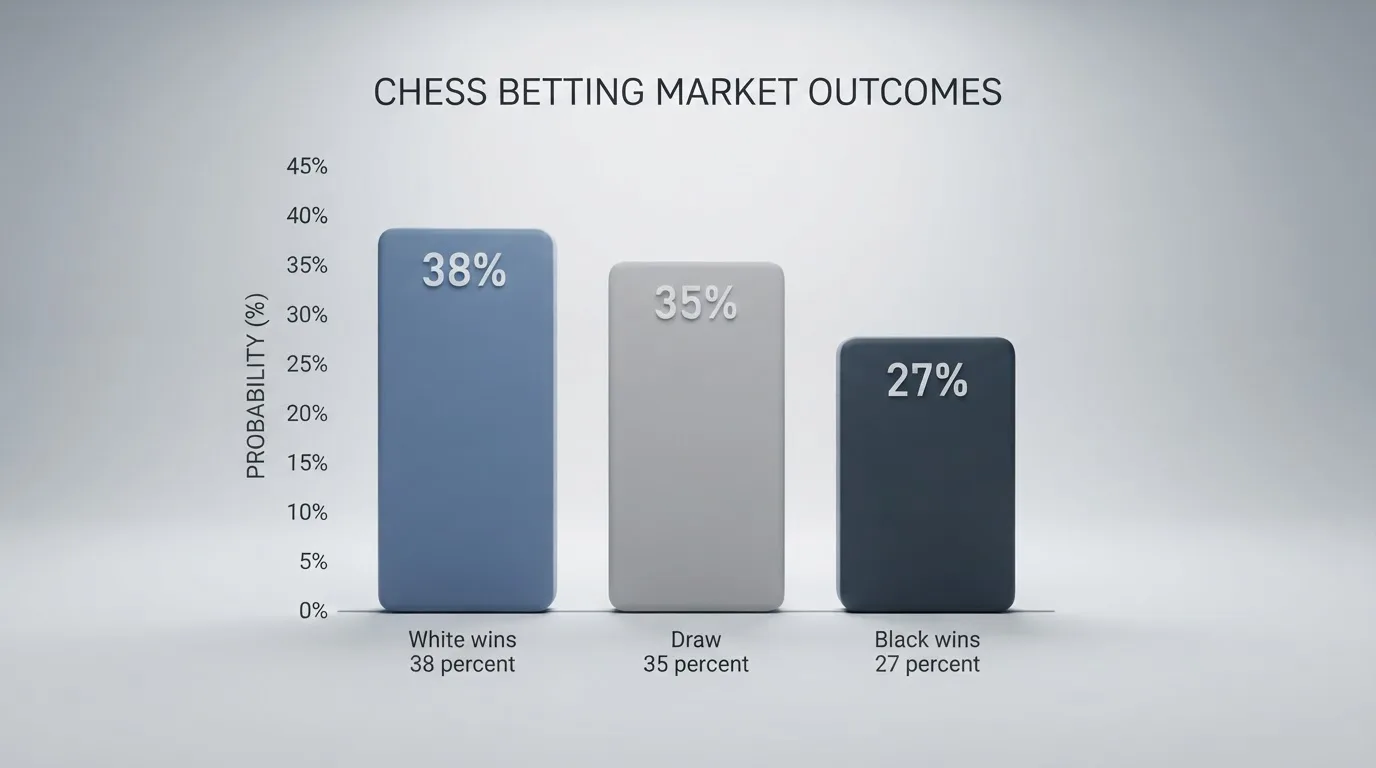
That shape ripples through the whole market. The two-outcome markets (match winner, sometimes called “moneyline”) sit closer together than in a sport with a clear favourite: 1.70 and 2.40 instead of 1.45 and 3.20. The draw line carries more volume, and a bet builder that chains “White to win” with “over 60 moves” cannot be priced the same way as “team to win and over 2.5 goals”, because the underlying correlation is different. Anyone reading a price on a chess match should first look at the draw column. A bookmaker whose draw price is missing or priced badly has a market the trader has not thought through.
Games are also drawn in ways the rule book names explicitly, and those rulings settle slips. Stalemate — the player to move has no legal move and is not in check — ends the game as a draw. So do threefold repetition (the same position three times with the same player to move) and the fifty-move rule (no capture and no pawn move in fifty moves), with a fivefold-repetition and 75-move auto-end since 2014. The two players can also agree a draw at any moment. A slip that says “White to win” is void if the players shake hands; the bookmaker settles on the result FIDE records, not on who looked better.
The bet types and how they pay
Three families cover almost everything a licensed bookmaker will list on a chess event.
The first is the three-way result. A single stake on White, on Black or on the draw. This is the market a reader should start on, because it carries the cleanest price comparison across bookmakers and the easiest margin calculation. It is also the only chess market where the bettor can be sure every licensed bookmaker is talking about the same thing.
The second is the series-winner market, which settles on who wins the match rather than a single game. A World Championship match is best of fourteen games; the first player to score 7½ points wins, and ties are broken by rapid play-offs. A bookmaker offers “Player A to win the match” alongside per-game prices, and the relationship between the two is itself a market, because the underdog’s per-game price compresses once they are a game ahead. A bettor who takes the per-game draw in a 6–6 situation is taking a very different bet from one who took it at 0–0; the price, not the stake, carries the information.
The third is the specials, which vary event by event. “Game to go over 40 moves”, “no draw offered”, “first blood” (a capture on a given move), “over/under on total moves in the match”, and the live markets that open after move one: “next game result”, “draw offered and declined”, “piece captured in the next five moves”. These are the markets where the margin runs highest and the limits are lowest, because the model is thinner and the bookmaker is exposed to a sophisticated audience that thinks in centipawns. A reader who plays the specials pays for the privilege twice: a wider margin and a tighter cap on stake.
There is one market the bettor sees on every sport that does not exist in chess: the handicap. Asian handicaps, European handicaps, spread betting on goals — none of them translate, because chess has no continuous variable to handicap against. The bet types on a chess slip are shorter than on a football slip, and the absence is a feature of the sport, not a gap in the bookmaker.
What the margin on a chess market actually looks like
The bookmaker’s margin is the slice of every pound staked that the firm keeps, on average, across all outcomes of a market. On a two-way market priced 1.90 / 1.90 — a deliberately even example, not a quoted price — the arithmetic is plain: the implied probabilities add to 1 ÷ 1.90 + 1 ÷ 1.90, which is 0.5263 + 0.5263 = 1.0526. The payout share, the fraction of the pool returned to bettors in the long run, is the reciprocal: 1 ÷ 1.0526 = 0.95, or 95 per cent. The margin is the difference: 5 per cent of every pound staked stays with the bookmaker.
That 5 per cent is the cost of taking the price. On a £10 stake at 1.90, a winning bet returns £19; over enough bets, the bettor keeps 95 per cent of what they would have kept at “true” odds. On the same market priced 1.80 / 1.80 — the same event, but a thinner book — the implied probabilities add to 1.1111, the payout share drops to 90 per cent and the margin climbs to 10 per cent. The bettor’s expected loss on the second market, per pound staked, is double the first. The headline price is identical in shape; the cost is not.
A worked comparison for a £10 single at 1.90 with a 5 per cent margin: net loss per bet, in expectation, is £10 × 0.05 = £0.50. The same £10 at 1.80 with a 10 per cent margin costs £1.00 in expectation. The two slips look the same at the counter; only the decimal odds carry the difference. A bookmaker that posts 1.85 on a coin-flip chess game is offering a 8.1 per cent margin (1 ÷ 1.85 + 1 ÷ 1.85 = 1.0811, payout share 92.5 per cent, margin 7.5 per cent); a bookmaker that posts 1.95 is offering a 2.6 per cent margin. The reader’s job, on every market, is the same arithmetic.
Chess markets sit higher on that scale than mainstream sports. A Premier League 1X2 with margin around three per cent is normal; a chess match winner with margin around five to seven per cent is normal, and the specials can run ten or higher. The reader pays a structural premium for the sport, and the only way to bring it down is to take fewer specials, take the price earlier (the closing line is usually sharper than the opening line), and avoid markets where the bookmaker is the only price on the screen.
In-play and the cost of a market that does not pause
In-play chess betting exists, and it costs the bettor more than pre-match for the same reason it costs the bookmaker more: the game does not stop. A football in-play market can be paused for a goal, a card, a VAR check; the trader watches, the model updates, the price moves. A chess in-play market has to be priced continuously, on a clock, for an event whose value function (the engine evaluation) is partly public. Strong players and their teams can read the position in real time, and a bookmaker who prices move 22 on a live board is competing with anyone in the world who can install Stockfish.
The practical effect is that live chess prices move on smaller information than live football prices, and they move faster. The overround widens, the limits are cut, and the markets that survive to move 30 are a short list: match result (re-priced from the current state), next-game result, sometimes a draw-offered market. The deeper specials usually close well before the endgame, because the bookmaker’s exposure on a 60-move total, in a position the model calls dead drawn, is unrecoverable.
Cash out on a chess bet works mechanically, but the price offered is the bookmaker’s price, not the market’s. A bettor with a winning position on a White-to-win single at move 35 of a dead-drawn game will be offered a cash-out value that reflects the bookmaker’s view of the remaining variance, which is wider than the bettor’s view because the bookmaker is pricing the worst case, not the expected one. The cost of cash out is the spread between the offered value and the true probability-weighted value; on a thin market that spread is wide.
The licence check: the only test that matters
A bookmaker serving customers in Great Britain needs a Gambling Commission remote licence. The Commission’s public register is the whole test: it is searchable by business name, trading name, account number or domain, and the entry lists the licence categories the firm is permitted to operate under. The relevant category for chess is “remote general betting standard (real events)”, and the licence number on the register is the licence number the bookmaker should display in the footer of its own site. Where the two do not match, the bettor should not deposit.
There is no shortcut. The Commission does not publish a “list of approved bookmakers”; a count of “licensed operators” depends on the day it was taken and the search terms used, and the reader should treat any quoted number as a snapshot, not a fact. The same is true of a .co.uk domain — a licensed operator can run on .com, and a domain proves nothing on its own. The check is the register entry, the licence number, and the category.
The register also shows the licence holder, which is sometimes a parent company rather than the trading name on the slip. Several well-known brands sit under the same licence holder; the bettor sees two brands, the register shows one. That is normal and not a problem in itself — what matters is that the holder is named, the licence is in force, and the categories cover the markets the bettor intends to use.
What the licence does and does not buy the bettor
A Gambling Commission licence is a package of obligations, not a guarantee of outcomes. The headline pieces are the ones a bettor notices in the small print: minimum age 18, identity verification before the first deposit, source-of-funds checks at higher spend, GAMSTOP coverage (a national multi-operator self-exclusion scheme, a licence condition since 31 March 2020), and a financial vulnerability check that triggers when deposits minus withdrawals exceed £150 in a rolling 30-day window (in force since 28 February 2025). The bettor pays for these in time: the verification step is mandatory, it cannot be skipped, and no licensed site offers anonymous play. That is a cost the reader accepts as the price of using a regulated market.
Wagering requirements on bonuses are capped: a £10 bonus at 50x wagering — which would be £500 of qualifying bets — is not allowed; under the rule that took effect on 19 January 2026, the multiplier on the bonus is capped at 10x, so a £10 bonus can require at most £100 of qualifying bets. Mixed-product promotions — an offer that requires the customer to gamble on two or more product types to release a reward, such as “bet on football to get free spins” — are banned. These rules are why a “£50 free bet” headline at a licensed bookmaker is a different object from the same headline at an unlicensed one: the licensed version has a ceiling on what the reader has to do to clear it.
The player pays no tax on betting winnings in Great Britain; General Betting Duty is the operator’s tax on gross profit, currently 15 per cent, with a new remote rate of 25 per cent scheduled to apply from 1 April 2027 alongside the existing 15 per cent rate. Whether the operator passes duty on through the odds is not established; the bettor should never assume the price they see is post-duty.
The betting sites that take chess seriously
Ten brands sit on the comparison below. Each holds a Gambling Commission remote betting licence for Great Britain; each is on the Commission’s public register; each is named against the licence number the register shows. The order is not a ranking and not a recommendation — the only way to compare two bookmakers on chess is to look at the price of the same event on the same day, and the markets change by the hour.
Three things matter for a chess punter: whether the brand prices the event at all (many bookmakers carry chess only around the World Championship cycle), how the in-play product handles a long game, and what the welcome offer actually costs in qualifying bets. A welcome offer is described qualitatively on this page; the terms that govern the qualifying bets, the minimum odds, the expiry window and the cap on free-bet winnings are the ones that turn a headline into a number.
| Brand | Gambling Commission remote licence | What the operator’s own terms state on chess |
|---|---|---|
| Betfred | 039544-R-319290-010, held by Petfre (Gibraltar) Limited | Chess is offered on major events through the sportsbook; pre-match and in-play markets are listed on the standard slip with cash out on selected events |
| BetMGM | 039198-R-319450-029, held by LeoVegas Gaming PLC | Chess appears as a category on the sportsbook; pricing is event-by-event, with bet builder availability dependent on the fixture |
| Bet600 | 044731-R-323941-016, held by Tyche Tech Limited | Chess is offered on headline events alongside horse racing, where Best Odds Guaranteed applies to SP-versus-early-price differences |
| 10bet | 043173-R-322899-023, held by Blue Star Planet Limited | Chess is carried on the sportsbook alongside football, tennis and horse racing, with Cash out, Bet Builder and Live Streaming on selected events |
| DragonBet | 064908-R-339041-003, held by DragonBet Ltd | Chess appears as a category on the sportsbook; the focus of the markets is Welsh football, Welsh rugby, racing and American football |
| Fitzwilliam Sports | 048760-R-335434-009, held by SBKI Limited | Chess is offered case-by-case; the firm is a Dublin bookmaker with a capped membership and a “High Stakes Welcome” subject to compliance criteria |
| Bar One Racing | 056516-R-332750-007, held by Bar-One Racing Limited | Chess appears on the sportsbook; the brand has rebranded to BAR 1 Betting and the strength of the offer is Irish racing with shops across Ireland |
| Midnite | 101839-R-342850-001, held by Midnite Limited | Chess is offered on the sportsbook with in-play events, an acca builder, popular accas and price boosts subject to maximum-stake limits |
| Paddy Power | 039439-R-319330-013, held by PPB Counterparty Services Limited | Chess appears on the sportsbook; the strength of the price menu is football, horse racing, boxing, rugby, tennis, golf, darts, snooker and F1 |
| NetBet | 039170-R-319343-032, held by Netbet Enterprises Limited | Chess is offered on the sportsbook; the firm runs Daily Boosts, Profit Boosts and a Bet Builder with instant dynamic odds |
A column that the comparison does not show is the margin on a specific chess fixture. The margin is a snapshot of one market on one event on one day at one bookmaker; it varies event by event and is not a property of the brand. A reader who wants the figure for an event they intend to back should take it from the price on the slip and do the arithmetic in the margin section above.
Betfred
The brand runs the standard sportsbook structure and prices the headline chess events when they fall: the World Championship match, the Candidates, the Grand Chess Tour finals. The slip looks the same as a football slip, with three-way result as the spine, and cash out is available on selected events. Best Odds Guaranteed on horse racing is a separate product and does not extend to chess; the bettor who is used to “SP or bigger” on a 3.20 Pontefract runner should not expect the same on a Candidates game.
The sportsbook also covers 21 sports and over 2,000 casino-style games in the app, which is a clue to its centre of gravity. Chess is a small slice. The welcome offer is described qualitatively; the terms set the qualifying bet, the minimum odds and the expiry, and the cost of the welcome in qualifying turnover is the number that matters, not the headline.
The trade-off: a familiar name with a long British history, a working in-play product, and coverage of major chess tournaments as the calendar dictates.
BetMGM
The UK sportsbook is held under LeoVegas Gaming PLC and the offer on the table for new UK customers is four £10 free bets (two football accumulators of 4+ selections and two sports multiples of 2+), valid for 7 days, with a £10 minimum deposit and a sports bet within 7 days. The free bets require opt-in and carry minimum-odds conditions; the stake on a free bet is not paid back with a win at most licensed bookmakers, and that is the standard shape here too. The reader who takes the offer is paying for it in the qualifying deposit bet and the time pressure of a 7-day window.
Chess is carried event by event. The bet builder is a feature on the slip and its availability on a chess fixture depends on the menu the trader has built; a bettor who wants to combine “White to win” with “over 40 moves” should check the event page rather than assume the builder will be there. The welcome offer’s centre of gravity is football; chess is not the headline.
The trade-off: a strong casino pedigree, a sports welcome offer that is a free-bet package rather than cash, and pricing for headline chess events that remains quiet for secondary fixtures.
Bet600
The brand pays Best Odds Guaranteed on horse racing, and that is the centre of the offer: if the starting price on a race is bigger than the price the bettor took, the bet is paid at the SP. Chess is offered alongside, and the bettor who lands on the slip from a racing page should not assume the BOG rule extends; it does not.
The sportsbook is run by Tyche Tech Limited and the licence on the Commission’s register is in good order. The welcome offer is described qualitatively; the qualifying terms are the same shape as the rest of the market, and the cost is in the rollover rather than the headline. The brand’s centre of gravity is racing, and the chess book appears when the calendar is loud enough to justify it.
The trade-off: a Best Odds Guaranteed product for racing and specific markets for major chess matches.
10bet
The sportsbook covers football, tennis and horse racing as its staples, with Cash out, Bet Builder and Live Streaming on selected events. Chess is carried on the same platform; the bet builder’s availability on a given chess fixture depends on the menu, and live streaming is the kind of feature that depends on rights rather than the sport.
The licence is held by Blue Star Planet Limited and the register entry is in order. The welcome offer is described qualitatively; the qualifying terms and the minimum-odds conditions are the ones that turn a headline into a cost. A reader who is drawn to a brand because of the bet builder on football should test the same builder on a chess fixture before staking.
The trade-off: a mainstream sportsbook with a working bet builder and select chess betting opportunities.
DragonBet
The brand is published by DragonBet Ltd and the centre of gravity is Welsh football, Welsh rugby, racing and American football. Chess is carried on the sportsbook, but the depth of the chess book reflects the brand’s identity: it is not the primary market, and the menu of bet types on a chess fixture is narrower than on a Welsh football match.
In-play betting and bet builder markets are features on the platform, and the in-play product on a chess fixture has to compete with the brand’s other priorities. The welcome offer is described qualitatively; the terms carry the cost. A reader who wants a brand with a deep chess book and a fluent in-play product on long games will not find both here.
The trade-off: a brand with a clear identity in Welsh sport and occasional pricing for high-profile chess events.
Fitzwilliam Sports
A Dublin bookmaker with a capped membership, and a “High Stakes Welcome” subject to compliance criteria. The brand’s identity is high-stake, low-volume, and the welcome offer is shaped accordingly — it is a fit for a smaller pool of customers than the standard sign-up bonus at a mainstream brand. The reader who lands here is paying for the cap with the size of the qualifying requirements.
Chess is offered case by case, and the firm’s responsible-gambling page sets out instant deposits, fast withdrawals, timeouts and deposit limits alongside links to GambleAware, GamStop and Gamblers Anonymous. The deposit-limit offering is the consumer’s choice, not a state-set ceiling, and that is the standard shape at every licensed brand.
The trade-off: a high-stakes welcome with compliance conditions, a capped membership, and sporadic chess pricing driven by the firm’s choice.
Bar One Racing
The brand has rebranded to BAR 1 Betting and is an Irish independent with shops across Ireland, horse racing sponsorships at Dundalk, Fairyhouse, Navan, The Curragh, Curraheen Park and Cork. The centre of gravity is Irish racing and the in-person betting shop, and the online sportsbook runs alongside. Chess is offered on the sportsbook, but the depth of the book follows the brand’s identity rather than the chess calendar.
The licence is held by Bar-One Racing Limited and the register entry is verified. The welcome offer is described qualitatively; the terms and the rollover are the cost. A reader who is shopping for a chess book will not find it leading the slip here.
The trade-off: an Irish racing book with a sportsbook attached, and selective chess markets for major headline events.
Midnite
The brand’s UK site shows a sportsbook with in-play events, an acca builder, popular accas and price boosts with maximum-stake limits. The welcome offer for new customers who bet £5 or more on pre-match odds of EVS (2.0) or greater within 14 days of sign-up is £25 in free bets and 50 free spins, valid for 7 days. The free-bet stake is not returned on a win at most licensed bookmakers, and the 7-day window is tight for a sport that runs on a longer rhythm than football.
Chess is carried on the sportsbook, and the acca builder is available where the trader has built the menu. The price-boost feature is interesting on a thin market: a boost on a chess fixture is a wider spread than a boost on football, because the underlying margin is wider. The reader pays the boost back through the qualifying bet and the maximum-stake cap.
The trade-off: a sportsbook with a working acca builder, a free-bet welcome with a 14-day qualifying window, and a chess book that covers the calendar’s key moments.
Paddy Power
The brand is published by Paddy Power PLC and the sportsbook’s strength is football, horse racing, boxing, rugby, tennis, golf, darts, snooker and F1. Chess is carried on the same platform, but the price menu reflects the centre of gravity: the depth on a Champions League final is not the depth on a Candidates game.
The licence is held by PPB Counterparty Services Limited and the register entry is in order. The welcome offer is described qualitatively; the terms and the qualifying rollover are the cost, and the brand is known for promotional pricing that carries its own conditions. A reader who treats chess as the main event will find the slip thinner than on football.
The trade-off: a mainstream brand with a deep football and racing product and a chess book that focuses on the headline events.
NetBet
The sportsbook offers Daily Boosts, Profit Boosts and free bet offers, a Bet Builder with instant dynamic odds, and sports stats for major leagues. Chess is carried on the platform, and the bet builder’s availability on a given chess fixture depends on the menu.
The licence is held by Netbet Enterprises Limited and the register entry is in order. The welcome offer is described qualitatively; the terms and the rollover are the cost. The brand’s strength is the boost product, and a boost on a thin chess market is a wider spread than a boost on a major sport.
The trade-off: a sportsbook with a working boost product, a Bet Builder with dynamic odds, and a chess book that follows the calendar.
Statute: what FIDE’s rules mean for the bettor
The rules of chess are not sportsbook rules, and the bettor does not have to learn them to take a price. But three FIDE rulings settle slips, and a reader who has not met them will not know why a winning position can become a void bet. Stalemate is a draw, not a loss for the player to move. Threefold repetition and the fifty-move rule, claimed by a player, end the game as a draw; since 2014, fivefold repetition and a 75-move rule end the game automatically. Players can also agree a draw at any moment, and they do — a handshake after a 30-move repetition sequence is the most common reason a “White to win” slip settles as a draw.

The World Championship cycle runs on a classical match format with rapid and blitz tie-breaks. The 2024 World Championship match, won by Gukesh Dommaraju, was best of fourteen games with rapid play-offs; the same format is expected for the 2026 cycle. A “match winner” market settles on the first player to score 7½ points, and a tied classical match (each player on 6 points after 12 games, for example) is settled by the rapid play-offs, not by a referee decision. A bettor who takes “match to go to tie-breaks” is taking a bet on the classical score, not on the final result.
The bookmaker settles on the result FIDE records, not on engine evaluation. A position the computer calls “+3” (winning for White by three pawns’ worth) is still drawn if the players agree. The bettor’s edge is in reading the market, not in reading the board; the engine view is already in the price.
Responsible gambling: the consumer’s costs
The cost of using a licensed market is not only the margin on the slip. It is the verification before the first deposit (mandatory, no exceptions), the source-of-funds check at higher spend, and the time-cost of being asked to confirm identity with a passport and a recent utility bill. The licensed bookmaker is also required to offer GAMSTOP self-exclusion, deposit limits, timeouts and reality checks; the bettor who wants to use a deposit limit has to set it themselves, because there is no state-set ceiling in Great Britain.
A financial vulnerability check (LCCP condition 3.4.4) is triggered when deposits minus withdrawals exceed £150 in a rolling 30-day window. The check is a public-record check (bankruptcy, county court judgments and the like), not an income check and not a credit reference check. Financial risk assessments — the affordability checks of the press — were announced in a staged plan in July 2026 with no start date; the bettor should expect them at higher spend but should not assume the headline “affordability check” applies on every deposit.
The bettor who wants help has a clear route. GamCare runs the National Gambling Helpline; GambleAware signposts to support; the NHS runs gambling clinics in person and online; Gamblers Anonymous runs peer-support meetings. A licensed bookmaker’s safer-gambling page links to these services, and the bettor who has self-excluded through GAMSTOP is blocked at every licensed online operator for the chosen period (six months, one year, five years, or five years with auto-renewal).
The unlicensed alternative is the cost the bettor pays when the protections do not apply: no GAMSTOP coverage, no Commission complaints route, no approved dispute-resolution body, no British consumer redress if funds are withheld, no cap on bonus wagering, no £150 vulnerability check. The licensed market is not a free good; it is a market that takes a cut of the price and gives the consumer a route back if the cut becomes a problem.
Mobile and the cost of a small screen
A chess game on a phone is a different experience from a chess game on a trading terminal, and a bookmaker’s app has to handle both. The in-play product on a long game is the test: does the price update cleanly when the bettor backgrounds the app for five minutes? Does the cash-out button stay live when the screen sleeps? Does the bet builder remember the selections when the bettor switches to check the position on a chess site?
Most licensed bookmakers run native iOS and Android apps alongside the mobile site, and the difference is mostly in the polish. The bettor pays for the app in two ways: the data cost of a live event with engine analysis in a second window, and the time cost of navigating a sportsbook app that was designed for football first. A chess fixture sits two or three taps from the home screen at most brands; the bettor who spends ten minutes finding the World Championship market is paying a friction cost the bookmaker has not removed.
The bet builder on a mobile app is where the cost shows. A bet builder that needs six taps to combine “White to win” with “over 40 moves” is a different object from one that needs two; the bettor who builds multi-leg bets on a small screen pays the friction in abandoned slips and missed prices.
The cost of a tip, a system or a tipster
Chess is a sport with a public information layer that football does not have. Engine evaluations are published in real time on chess sites, tablebases resolve the endgame, and a bettor with a strong engine running and a hundred clock-minutes a day can build a model the bookmaker has not priced. The opportunity is real; the cost is the time, and the assumption that the bookmaker does not have the same engine running on the same position.
A “system” that wins on chess is a system that prices what the bookmaker has mispriced, and the bookmaker’s trading team has the same engine, the same tablebase and the same clock. The bettor’s edge, when it exists, is information the model has not absorbed — a rumour about a player’s health, a known weakness in a particular opening, a travel schedule that affects prep. The model absorbs the rest.
The bettor who buys a tip from a tipster is paying for a flow of information the tipster has not priced. A tip is a recommendation at a price, and the price is the one on the slip when the tip arrives. By the time the tip has been published and read and acted on, the price has moved. The tipster’s edge, when it exists, is the speed of the channel; the bettor’s edge, when it exists, is the same channel. The bettor pays the tipster for something the bettor could have done faster, and the cost is the subscription.
The honest framing is: chess betting odds are a price for a probability, and the bettor’s job is to find a price that is wrong. Most prices are right. The bettor’s edge is in the few that are not, and the cost of looking is the time spent looking.
Strategy, in two lines
The cheapest way to bet on chess is the simplest. Take the three-way result on a headline event, compare the price across two or three bookmakers, take the one with the lowest margin, and stop. The specials are wider, the in-play specials are wider still, and the bet builder on a chess fixture is a price the bookmaker has had less time to sharpen. The reader who treats chess as a one-market sport pays less in margin than the reader who treats it as a ten-market sport.
The second line is harder. The closing line on a chess fixture is usually sharper than the opening line, because the model has had longer to run. The bettor who takes the price the night before pays a wider margin than the bettor who takes the price an hour before the move. The trade-off is the limit: a hot match may have its limit cut before the close, and the bettor who waits may find the stake they wanted is no longer available. The cost of waiting is the chance the price is taken off the board.
The tax, the duty and the cost the bettor does not pay
The player pays no tax on betting winnings in Great Britain; General Betting Duty is the operator’s tax, not the bettor’s. Whether the operator passes the duty on through the odds is not established, and the bettor should not assume the price they see is post-duty. The remote rate of General Betting Duty is currently 15 per cent, with a new 25 per cent remote rate scheduled to apply from 1 April 2027 alongside the existing 15 per cent rate; whether the 25 per cent rate changes the price the bettor sees is a question for the operators’ trading teams, not for the page. A professional gambler should ask HMRC or an adviser; this page does not give tax advice.
The offshore alternative and what the bettor gives up
A bookmaker licensed in Curaçao, Malta or Gibraltar is not licensed to take bets from customers in Great Britain. The legal exposure is the operator’s, not the bettor’s, and the bettor who uses such a site does so outside the British consumer-protection frame. The trade is real: a wider welcome offer, looser verification, a price the British bookmaker is not posting. The cost is the protections: no GAMSTOP coverage, no Commission complaints route, no approved dispute-resolution body, no British consumer redress if funds are withheld, no cap on bonus wagering, no £150 vulnerability check, no deposit-limit duty on the operator. The bettor who uses an offshore site pays the headline price in cash and the protection in its absence. The honest framing is not “safe” or “unsafe”; it is the set of protections the bettor is using and the set they are not.
The Commission’s enforcement is disruption, not blocking: cease-and-desist notices, search-engine referrals, work with registrars, hosts and payment providers. Court-order DNS blocking powers have been granted or are about to be granted; the bettor should not assume an ISP block is in operation. The bettor who reaches an unlicensed site from a British ISP has reached it because the block has not been put in place, not because the site is licensed.
How to read a price in three steps
The page has covered the margin, the bet types, the licence and the cost. The mechanics, for the bettor who has not done them before, are three steps.
The first is the stake and the odds. A £10 single at 1.90 returns £19 if it wins — the stake of £10 plus the profit of £9. The arithmetic is stake × odds for the return and stake × (odds − 1) for the profit. A combination bet, sometimes called an accumulator or acca, multiplies the odds of the legs into one price: two legs at 1.90 and 1.80 is a single price of 1.90 × 1.80 = 3.42, and a £10 stake returns £34.20 if both legs win.
The second is the result. The bookmaker settles on the result FIDE records. A 1–0 score on the scoresheet is a White win on the slip, a 0–1 is a Black win, a ½–½ is a draw. A bet on White to win is void if the players agree a draw. A bet on the match winner is settled on the first player to score 7½ points, and a tied classical match is settled by the rapid play-offs.
The third is the cost. The margin is the slice of every pound staked that the bookmaker keeps, on average, over many bets. A market priced 1.90 / 1.90 carries a 5 per cent margin; a market priced 1.80 / 1.80 carries a 10 per cent margin. The same slip, the same stake, the same outcome — the cost is in the decimal odds. The bettor’s job, on every market, is the arithmetic in the margin section above.
Frequently asked questions
Where can chess be bet on in Great Britain?
A licensed bookmaker serving customers in Great Britain needs a Gambling Commission remote betting licence, and the Commission’s public register is the whole test. The brand’s name, the licence holder, the licence number and the licence category — “remote general betting standard (real events)” for chess — should all match between the register entry and the brand’s own footer. The ten brands on the comparison above all sit on the register; the bettor who wants a brand outside the comparison should run the same check before depositing.
Is chess betting legal in Great Britain?
There is no statutory list of permitted sports or markets, and a licensed bookmaker may offer chess under its own licence conditions. A bookmaker serving customers in Great Britain needs a Gambling Commission licence wherever it is based; a Curaçao, Maltese or Gibraltar licence is not a substitute. The bettor who uses a licensed bookmaker is using a regulated market; the bettor who uses an unlicensed bookmaker is outside the British consumer-protection frame, and the cost of that is the protections they are not using.
How does a bet on chess actually work?
A bet is a stake on an outcome at a price. A £10 single on White to win at 1.90 returns £19 if White wins and the stake is lost if White does not. A combination bet multiplies the prices of its legs into one. The bookmaker settles on the result FIDE records, and a draw agreed by the players settles as a draw on the slip. The chess-specific mechanics are the result codes (1–0, 0–1, ½–½) and the draw outcomes (stalemate, threefold repetition, the fifty-move rule, agreement between the players).
How is a Gambling Commission licence checked?
The Commission’s public register is searchable by business name, trading name, domain or account number. The relevant category for chess is “remote general betting standard (real events)”. The licence number on the register should match the licence number the bookmaker displays in its footer, and the licence should be in force. A .co.uk domain is not a check; licensed operators use .com as well. A brand that does not appear on the register, or that appears under a different licence category, is not licensed to take bets on chess from customers in Great Britain.
How is the return on a bet worked out from the stake and the odds?
The return on a winning bet is the stake multiplied by the decimal odds. A £10 stake at decimal odds 1.90 returns £19 — the £10 stake plus £9 of profit. The profit on its own is the stake multiplied by the odds minus one. A combination bet multiplies the odds of the legs into one price: two legs at 1.90 and 1.80 gives a combined price of 3.42, and a £10 stake returns £34.20 if both legs win. The arithmetic is the same on every market; the difference is the margin baked into the price.
What is the bookmaker’s margin and how is it seen in the odds?
The margin is the slice of every pound staked that the bookmaker keeps, on average, across all outcomes of a market. On a two-way market priced 1.90 / 1.90, the implied probabilities add to 1.0526, the payout share is 95 per cent, and the margin is 5 per cent. A market priced 1.80 / 1.80 carries a 10 per cent margin; the bettor’s expected loss on the second market, per pound staked, is double the first. The margin is the cost of taking the price, and the bettor’s job, on every market, is the same arithmetic.
Tennis, darts & cue sports – Racingtipshub.com
Content created by the «Racingtipshub.com» team
